The IT’s “Gold Rush” is Over: Why AI is Finally Filtering the Industry


For years, we confused “coding” with “engineering.” In 2026, the market is correcting that mistake. Let’s be honest about where we are.
For the last decade, we handed out the title “Software Engineer” to anyone who could write a React component or spin up a Node.js server. The industry standard for a “good developer” was someone who could pick up a ticket from Jira, write the code, pass the tests, and move it to ‘Done.’
If you did that fast enough, you were a Senior. If you did it without breaking anything, you were a Lead.
That era is over.
We are now in 2026, and the reality is that if your job is to take a set of requirements and translate them into syntax, AI can already do that faster, cheaper, and with fewer syntax errors than you. If you are waiting for a task to be assigned to you so you can “go head down and code,” you are in danger.
Software Development vs Software Engineering
We are finally seeing the massive difference. A distinction that AI has exposed.
Software Development is the act of writing code to implement a feature. It is about “making it work”. It is the translation of logic into syntax. This is exactly what AI does best. It generates code, implements the function, and develops. If your daily routine consists of purely “developing” solutions to immediate problems, you are competing against a machine that runs at the speed of light.
Software Engineering is different. Engineering is not about writing code; it is about designing systems that survive time.
Engineering is the management of constraints. It is asking:
- “If we build it this way, how much will it cost to maintain in two years?”
- “What happens to the database when the user base triples?”
- “Is this dependency necessary, or is it a security risk?”
The “Developer” role, the person who types the syntax, is disappearing. The “Engineer” role, the person who understands the cost models, the lifecycle, and the trade-offs, is the only thing left (or even needed).
The Market Doesn’t Care About Your Clean Code
This isn’t just a philosophical shift, it’s a financial one.
In my recent collaborations, I’ve seen the walls between specializations crumble. Backend developers who “didn’t know CSS” are now shipping full-featured frontends. Frontend developers suddenly help with the endpoints they need. Developers who never touched DevOps are writing complex automation scripts.
Why? Because the barrier to entry - syntax and boilerplate - has vanished. AI allows us to reach a state where a single engineer can own the entire stack.
This speed is necessary because the market has changed. Clients are no longer willing to pay the premiums they previously accepted. They know technology has advanced. They don’t want to pay for your typing speed; they want to pay for the solution.
The cost model has crashed. If you are still trying to sell “hand-crafted code” at a premium hourly rate while your competitor is shipping working prototypes in real-time, you will lose.
The Role of Reverse Engineering
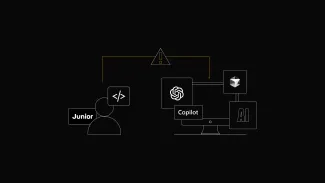
When you write code, you know the intent behind every variable. When you review AI code, you are effectively debugging a stranger’s work — a stranger who is incredibly fast, incredibly confident, and occasionally hallucinates.
I have to look at those generated lines and deconstruct them:
- “Why did it choose this specific pattern?”
- “Where is it hiding, the state?”
- “It handled the happy path perfectly, but where is the error boundary?”
This is the new bottleneck. It is no longer about how fast you can type. It is about how quickly you can audit without compromising quality.
The junior developers get trapped here. They see the output, run it, see that it works, and commit it. They trust the syntax. The senior engineer reviews the same output and validates it. We don’t just check if it runs; we check if it makes sense within the larger architecture. We reverse-engineer the “why” behind the “how”.
The Return of the “Pro”
I missed this feeling.
In the last few years, I’ve started to feel like anyone could be a software developer. I remember the times when the “programmer” was the smartest person in the room (and usually the weirdest nerd, too). But during my career, I felt the industry lost that “pro” feeling.
The “Gold Rush” brought in many people who came to IT solely for the big money. They didn’t care about the system; they cared about the paycheck.
The AI era is polarizing the coding community. It is separating the field into two groups:
- The Engineers: The ones with strong skills who actually understand what they are doing and are enthusiastic about building systems. I’m positive this era will bring more chances to meet those.
- The Tourists: The ones who were just here for the ride and will now either wake up very quickly or have to change their careers.
The Market is Ruthless but Fair
We are moving toward a world where every surviving developer must think like an architect. The “Code Monkey”, the person who unthinkingly executes Jira tickets, is a role that no longer adds value.
The market in 2026 is ruthless but fair. It rewards those who can leverage AI to do the heavy lifting while they focus on high-level problem solving, cost models, and architectural integrity.
You have two choices:
- Bump yourself up: Expand your scope. Learn the architecture. Become the person who reviews, judges, and ships.
- Be outcompeted: Stay in your lane, cling to your Jira tickets, and watch as others do your job 10x faster.
I know which one I’m choosing with my teams.